Reports suggest SpaceX (ticker: SPCX) could officially price its IPO on 11 June and begin trading on 12 June, in what may become one of the most significant equity listings in modern market history.
Current pricing discussions suggest SpaceX could launch with a market capitalisation of around $1.75 trillion to $1.8 trillion. If achieved, SPCX would immediately rank among the largest companies in the US equity market.
The company is reportedly raising around $75 billion, making it the largest IPO ever completed. Yet despite the scale of the capital raise, only around 4% of total shares are expected to be publicly tradable.
That combination of enormous investor interest, a tiny free float, an active options market and Elon Musk's involvement could create a stock unlike anything traders have seen before.
SpaceX IPO At A Glance
| Expected Listing | 12 June 2026 (pricing 11 June) |
| Exchange | NASDAQ |
| Est. Valuation | ~$1.8 Trillion |
| Target Raise | $75B |
| Free-float | 4% of Total Shares |
| Key Revenue Driver | Starlink, Launch Systems, Defence, AI Infrastructure |
| Nasdaq 100 Inclusion | ~15 Days Post-listing |
| S&P 500 Inclusion | 6+ Month Post-listing |
| Share Lockup | No New Shares For 180 Days |
| 2025 Revenue | $18.67B |
| 2025 Net Loss | -$4.9B |
| Trade with Pepperstone | CFDs Available |
| Pre-IPO Commission | No Commission (Spread Only) |
| SPCX.US Commission | 0.02 USD per lot (Min 0.02) |
One of the Biggest Market Events in Years
SpaceX has spent more than two decades operating as a private company, building leadership positions in satellite communications, launch systems and national security infrastructure.
The IPO represents a major shift, giving public market investors direct exposure to a business that has become central to the future of communications, defence, AI infrastructure and the broader Space Economy.
The scale alone is difficult to ignore. At a valuation approaching $1.8 trillion, SpaceX would immediately become one of the largest listed companies globally.
However, what makes SPCX particularly interesting is not simply its size. It is the extraordinary gap between how different investors may value the company.
Why the 4% Free Float Matters
Perhaps the most important feature of the IPO is the expected free float of just 4%.
A float this small is unusual for a company of this scale and has several implications.
First, Elon Musk maintains tight control of the business.
Second, a limited supply of shares creates scarcity, particularly if investor demand proves strong.
Third, a small float reduces the risk of broader market disruption. Had SpaceX floated a substantially larger percentage of the company, institutional investors may have needed to sell large portions of existing portfolios to fund allocations.
Instead, the relatively small float could support strong demand while limiting the supply of stock available to trade.
For traders, scarcity often translates into volatility.
Starlink Is the Engine of the Business Today
While much of the attention focuses on rockets and Mars, Starlink is increasingly the financial engine of the business.
Starlink has grown rapidly in recent years and now represents the majority of company revenue. The business generates recurring subscription income, benefits from strong network effects and continues to expand globally.
This is important because recurring revenue businesses typically command higher valuation multiples than traditional industrial businesses.
In many ways, investors are increasingly viewing SpaceX as a communications and infrastructure platform rather than simply a launch company.
Why Valuing SpaceX Is So Difficult
Traditional analysts will likely approach SpaceX using a sum-of-the-parts valuation model, making assumptions around revenue growth, cash flow, capital expenditure requirements and cost of capital.
Using that framework, some may argue the company's existing businesses justify a valuation significantly below current IPO expectations.
However, SpaceX is not positioning itself to investors as a traditional aerospace company.
Management is increasingly framing the business as a long-term AI infrastructure and Space Economy platform.
The vision extends beyond launch systems and satellite communications to include future opportunities in AI infrastructure, autonomous systems, compute, enterprise software and the broader digital economy.
That creates a significant challenge for investors.
The stock is likely to trade not on what the company earns today, but on what investors believe it could become over the next decade.
As a result, fair value estimates are likely to be widely dispersed, which is often the perfect recipe for volatility.
Why ETF Flows Could Matter
Many investors assume that a company with a market capitalisation approaching $1.8 trillion would immediately attract enormous passive inflows.
The reality is more nuanced.
Major indices calculate weightings using free-float adjusted market capitalisation rather than total market value.
Because only around 4% of shares are expected to be publicly available, SPCX may initially receive a smaller weighting in major indices than many investors expect.
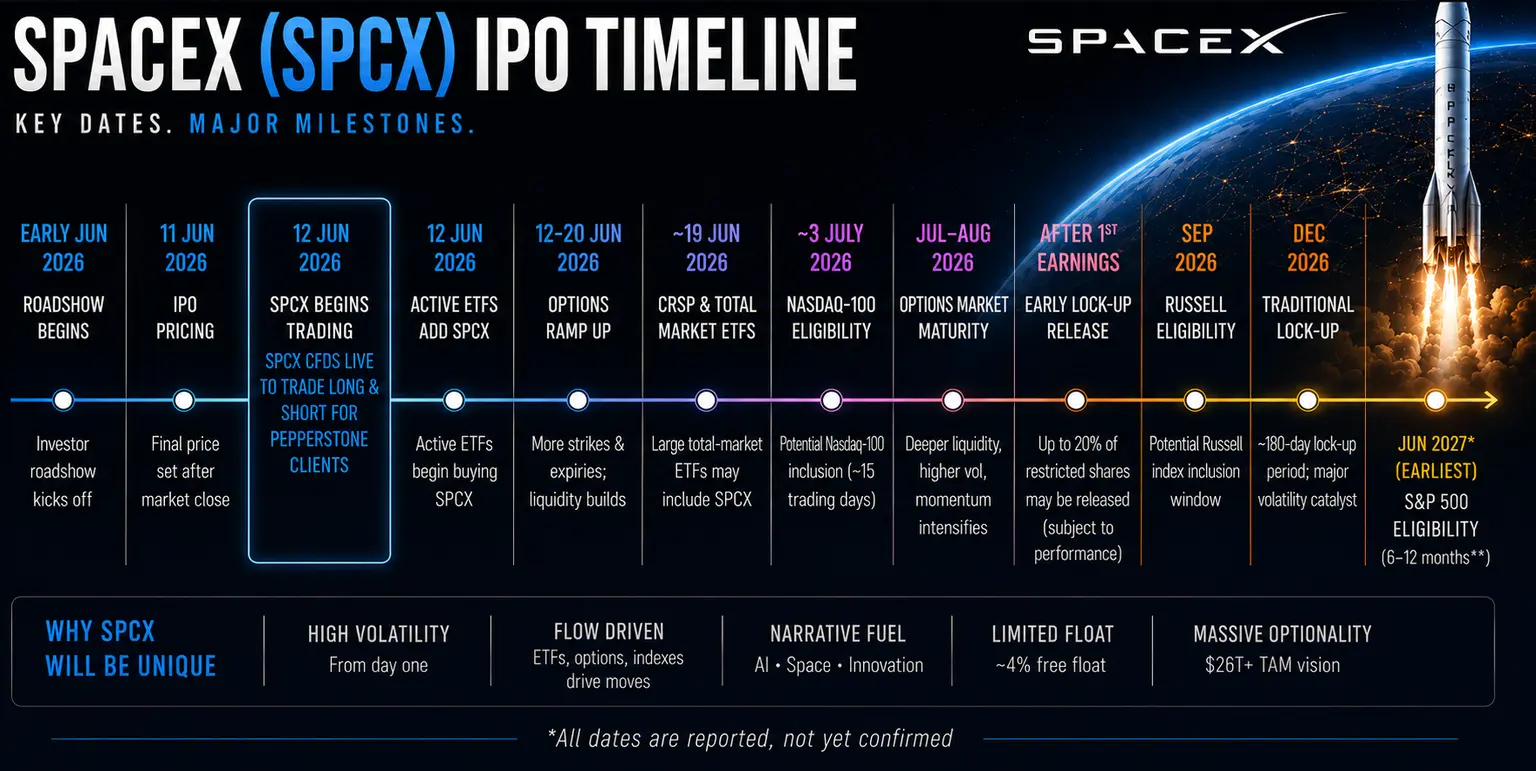
Current reports suggest SPCX could become eligible for inclusion in the Nasdaq 100 after roughly 15 trading days, while S&P 500 inclusion may take closer to six months.
While passive flows may initially disappoint some investors, active fund managers and active ETFs can begin buying from day one.
Over time, ETF rebalancing and passive fund demand could become an increasingly important driver of price action.
The Options Market Could Drive Huge Volatility
The options market may ultimately become one of the most important influences on SPCX price action.
Retail traders are expected to actively trade SPCX options, driven by the Elon Musk factor, the Space Economy narrative, the small free float and the expectation of elevated volatility.
As options activity increases, dealer hedging flows can amplify market moves.
This creates the potential for powerful momentum trends, sharp reversals and periods of exceptionally high realised volatility.
Combined with a limited supply of shares, these dynamics could make SPCX one of the most actively traded stocks in global markets.
The Space Economy Narrative
At its core, the SpaceX IPO is not simply about rockets.
Investors are increasingly buying exposure to a much broader investment theme.
That includes satellite communications, AI infrastructure, defence systems, autonomous logistics, global internet connectivity and the broader infrastructure layer underpinning the future Space Economy.
The company currently operates across four major areas:
• Starlink and satellite communications
• Launch systems and reusable rockets
• Defence and national security infrastructure
• AI and future infrastructure opportunities
Increasingly, investors view SpaceX as:
• The infrastructure layer of the future Space Economy
• A communications and defence platform
• An AI infrastructure business
• A long-term logistics and connectivity network
That narrative matters because modern markets increasingly trade on vision, scarcity and long-duration optionality.
Few companies embody those themes more than SpaceX.